At Advancing Innovation in Dermatology (AID), our mission is to catalyze transformative solutions for skin health. Behind this mission is a board of leaders whose experiences span academia, industry, policy, and entrepreneurship, each bringing a unique perspective to advancing innovation in dermatology.
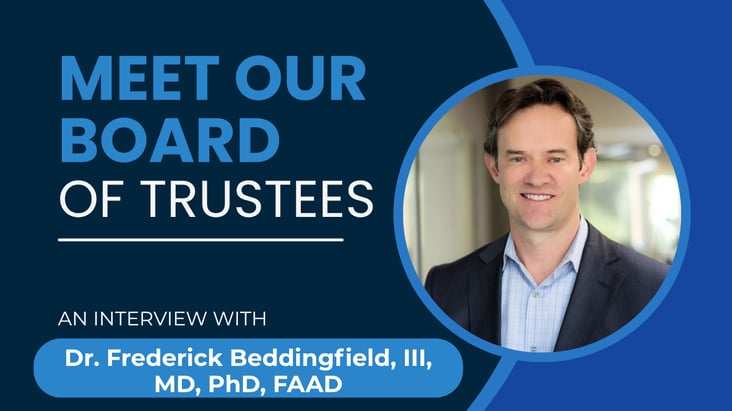
In this installment of our “Meet the Board” series, we’re honored to feature Dr. Frederick C. Beddingfield III, a physician-scientist and biotech entrepreneur whose career sits at the intersection of clinical dermatology and drug development. Dr. Beddingfield currently serves as CEO and Board Director of Rubedo Life Sciences. He is also Founder and Executive Chairman of Steelhead Therapeutics, a complement therapeutics company spun out of the Cleveland Clinic Foundation, and a board member of Neurodon, a company focused on cardiometabolic disease, sarcopenia, and neurodegeneration that is developing the first SERCA activator to restore cellular health. Previously, he was an Executive Partner at Apollo Health Ventures, a longevity and age-related disease fund. His other leadership roles include CEO of Kira Pharmaceuticals, founder and CEO of Sienna Biopharmaceuticals (which he took public in 2017), and Chief Medical Officer of Kythera Biopharmaceuticals through its acquisition by Allergan. During his ten years at Allergan, he served as Therapeutic Area Head of Dermatology and Chief Medical Officer of Allergan Medical, leading the development and approval of brands including Botox, Juvéderm, Voluma, Kybella, Latisse, Aczone, and Tazorac.
Dr. Beddingfield is board-certified in dermatology and emergency medicine, fellowship-trained in dermatologic surgery and cutaneous oncology, and holds an MD from UNC Chapel Hill and a PhD in Policy Analysis from RAND. He continues to teach at UCLA and serves on the medical advisory boards of the Children’s Skin Disease Foundation and Camp Wonder. In our conversation, he reflects on why AID’s community was so hard to find when he started his career, where he sees dermatology’s biggest opportunity today, and what it will take to give the next generation the ecosystem he had to build for himself.
What personally drew you to AID and its mission?
When I entered the pharmaceutical and biotech industry as a dermatologist, very few physicians in our field were working full-time in that world. There were almost no forums where you could talk to other people who understood both the clinical side and the drug development side. As I got to know people like Bill Ju and Seth Orlow, who helped start AID along with the Derm Summit and Derm Innovation Forum, I found others who shared that experience and, more importantly, shared the belief that we should be building an ecosystem around it. Companies are constantly looking for people with dermatology drug development experience, and there simply aren't enough of us. AID became a way to grow that community deliberately, so people could learn from each other rather than figure it all out alone.
Where did you see the biggest opportunity to change the future of dermatologic health when this community was first taking shape, and where do you see it now?
We were fortunate to start during a period of real evolution in the field, on two fronts. The first was the shift in autoimmune disease treatment, moving from traditional immunosuppressants toward biologics, which drew major pharmaceutical companies into dermatology for the first time in a meaningful way. The second was the emergence of medical aesthetics as its own category. I was at Allergan at the time, introducing products like Botox and fillers that quickly became central to the dermatology practice. Together, those two currents expanded what dermatology even meant as a field.
Looking forward, the biggest opportunity I see is the convergence of dermatology and longevity, or healthy aging. Instead of treating individual diseases in isolation, we're starting to look at the biological pathways that affect skin health and whole-body health together. GLP-1s are a good example: a drug approved for one condition is turning out to influence health far beyond it, and it's even changing why patients come into the dermatologist's office. I'm currently CEO of Rubedo, an age-related disease company that intentionally started in dermatology, because skin is a safe, accessible place to run early human trials and see what a drug is actually doing to aging tissue. I spent the first part of my career helping people look younger. Now the work is about helping skin actually be younger, and that shift is what excites me most right now.
From your perspective, what does the next generation of dermatology innovators need most right now?
Dermatology has always been an innovative field, going back to the days when dermatologists were literally compounding their own treatments. What I see now, teaching residents and fellows at UCLA, is a generation genuinely interested in working on new therapies. Their question is almost always the same: how do I actually get involved? How do I learn to do what you're doing? That's not something taught in medical school or residency. Figuring out how to develop a drug or device, how to file a patent, how to take an idea from something you noticed at the bedside to something that changes clinical practice, none of that is intuitive. People need others who are willing to teach it. I think that's exactly what AID does well, and it's the piece that was missing when I was coming up.
Where would you like to see AID in ten years?
I'd like to see this become something readily available to anyone with an interest in it, and eventually something built into training itself. It doesn't need to be mandatory, but for those who are curious, it should be accessible: peer-to-peer mentorship, which AID already sponsors and supports, fellowships, and real opportunities to get experience inside a biotech company working in dermatology. Some people come to this wanting to incorporate innovation into their career broadly, without a single idea they're chasing. Others have a specific idea from their clinical practice and no idea what to do with it. AID should be a resource for both of those people. I think we're already doing that well, but there's always more we can do.
What excites you most about the kinds of innovators AID is trying to cultivate, whether through the Entrepreneurial Showcase at our Derm Summit or the broader community?
The showcase gives startup companies a real platform, whether the audience is investors and bankers, or business development leaders from large pharma, to tell the world what they're building. We've got a strong track record with those companies: a number have gone public or been acquired. If you're at the Derm Summit, by definition you're interested in dermatologic innovation, so companies are speaking to exactly the right audience. Scheduling it the day before the JP Morgan Healthcare Conference was actually my idea, since thousands of people are already coming to San Francisco that week and can arrive half a day early to participate. That timing has turned out to be one of the more valuable things we built into the meeting, because it brings in the finance and investor perspective that small companies need alongside the clinical one.
Any final thoughts for our community?
Mostly that this has become a genuine source of friendship, not just professional connection. Some of my closest relationships in this industry came directly out of AID and the people I've met through the Derm Summit and DIF over the years. I feel fortunate to have been part of building it, and I'm glad to see it continuing to grow.
Join the Conversation at Derm Summit
Dr. Beddingfield helped shape Derm Summit into the place where dermatology innovators, investors, and industry leaders meet right before the biggest week in healthcare investing. Whether you’re developing a new therapy, building a company, or looking for the next breakthrough to back, this is where you’ll find your community.