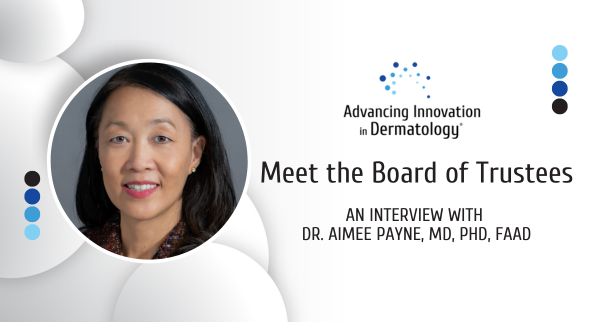
Get to know the people guiding AID’s strategy and priorities. Meet the Board takes you inside the minds of the leaders who help us evaluate what’s next in dermatology, what science is ready to translate, what gaps still need bold solutions, and how we can better fuel the innovators moving skin health forward.
Our next feature highlights Aimee Payne, MD, PhD, FAAD, the Herbert and Florence Irving Professor and Chair of Dermatology at Columbia University. Dr. Payne is a physician-scientist whose work sits at the intersection of dermatology, immunology, and next-generation therapeutics. Her lab focuses on the mechanisms and treatment of autoimmunity, especially B cell–mediated diseases like pemphigus and myasthenia gravis, and helped pioneer an approach to precision cellular therapy known as CAAR-T, advancing key studies that led to FDA clearance of two Investigational New Drug applications.
Beyond the lab, Dr. Payne is a builder of the ecosystem that turns science into impact: she co-founded Cabaletta Bio to help bring precision cellular immunotherapies for autoimmunity into human clinical trials, served as the 2024-2025 President of the Society for Investigative Dermatology, and has been recognized with multiple awards for innovative therapy and clinical research. Her perspective, spanning discovery, translation, and leadership, speaks directly to what AID is here to accelerate.
Read on to learn what drives Dr. Payne, how she thinks about the next wave of innovation in autoimmune skin disease, and why she believes this moment is pivotal for advancing better, more targeted therapies for patients.
What drew you to AID and its mission?
AID fills a unique niche in Dermatology by connecting innovators of novel technologies with the resources to help support commercial development, including education, entrepreneurial showcases at the Derm Summit and Dermatology Innovation Forum, and direct advice from the phenomenal duo of Bill Ju and Jamie Breslin. AID has helped connect two of our engineered cell therapy technologies with commercial development opportunities – one of these has now led to a publicly-traded biotechnology company.
When you think of the impact AID could have in 10 years, what do you envision?
One of the unique aspects of dermatology is that almost every cell type is in the skin, including immune cells, neurons, and even foreign cells such as microbes, and the clinical applications of Dermatology are also ripe for understanding how artificial intelligence can be used to improve healthcare delivery and novel diagnostics. So the potential fields of impact for innovation in dermatology are vast. Beyond traditional fields such as cancer and aging, pioneering studies in itch, immunomodulation and vaccination strategies, genetic medicines, cell therapies, digital dermatopathology, and learning healthcare systems all hold promise to improve the practice of dermatology and medicine more broadly.
We’re in a moment of rapid change across biotech and healthcare. Where do you see dermatology falling behind, and where is it breaking new ground?
Inflation-adjusted grant funding to academic institutions from the National Institutes of Health has declined since 2020, both in total dollars and number of awards, which has impacted resources to support new research innovations in dermatology. And yet, dermatology continues to be a proving ground for breakthrough technologies, due to the accessibility of skin and the ability to obtain proof-of-concept and proof-of-mechanism in early-stage studies. A beautiful example of this is that the first topical gene therapy approval in the United States (beremagene geperpavec-svdt) was for the inherited skin blistering disease dystrophic epidermolysis bullosa. Early-stage studies using skin biopsies from patients before and after therapy showed that the topical gene therapy restored normal protein function, ultimately supporting the drug’s FDA approval. Now, topical gene therapies are being tested for a broad range of diseases affecting the skin and other organ systems, including the eye and lung.
What excites you most about the kinds of innovators AID is trying to cultivate?
We are fortunate in Dermatology to be able to recruit from among the brightest and most accomplished physicians and scholars worldwide. AID has the ability to connect young innovators with accomplished entrepreneurs and resources to help refine and advance their ideas toward clinical use.